Coral Bell School Public Lecture
This presentation considers the complex and significant role of the Russian Orthodox church in Russia's war against Ukraine. Russia’s war against Ukraine is sustained by a powerful quasi-theological ideology created by the Moscow Patriarchate and adopted by the Kremlin. The Russian Orthodox Church fills the post Soviet ideological vacuum by offering metaphysical justification for violence, recasting the conflict as a cosmic struggle between sacred Russian “traditional values” and a demonic, allegedly Russophobic West. This ideological system—embraced by Putin, Medvedev, and a growing cadre of radicalised theologians—frames Russia as the katechon, the divinely appointed restrainer of evil, and Putin as its personalised embodiment, blending mythologised Byzantinism, apocalyptic rhetoric, and selective biblical hermeneutics to sacralize the state and sanctify the destruction of Ukraine. Church media and clergy further reinforce this worldview by portraying Ukrainians as renegade people deserving punishment, thus creating a modern form of clerical fascism (“Z theology”) that mirrors earlier European Christian-fascist movements.
Speaker
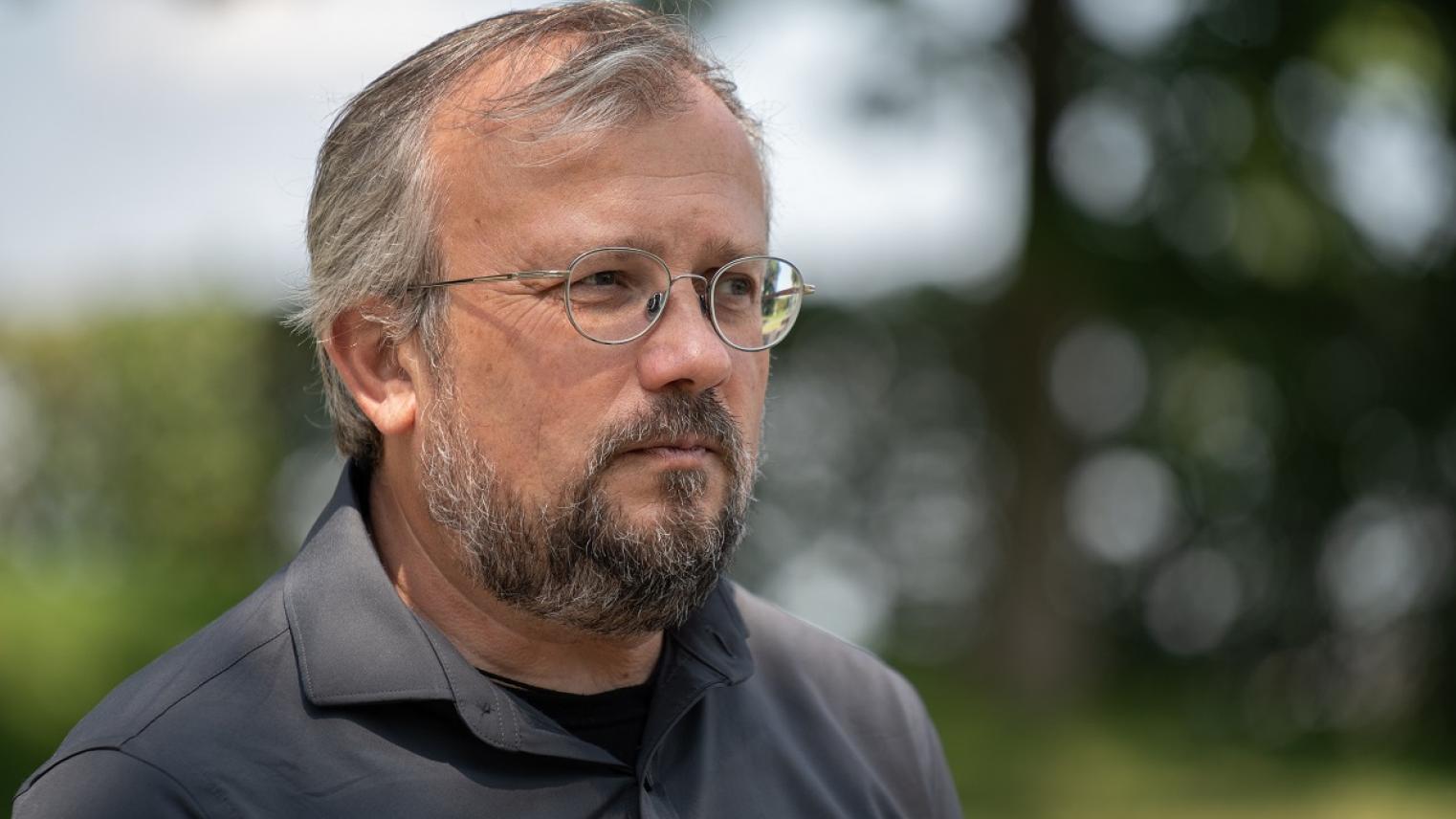
Cyril Hovorun is a professor of ecclesiology, international relations, and ecumenism at Stockholm School of Eastern Christian Studies, and serves as the director of the Huffington Ecumenical Institute at Loyola Marymount University in Los Angeles. A graduate of the Theological Academy in Kyiv and the National University in Athens, he completed his doctoral studies at Durham University under the supervision of Fr Andrew Louth. He has been chairman of the Department for External Church Relations of the Ukrainian Orthodox Church, first deputy chairman of the Educational Committee of the Russian Orthodox Church, and later a research fellow at Yale and Columbia Universities, as well as a visiting professor at the University of Münster in Germany. He is an international fellow at the Chester Ronning Centre for the Study of Religion and Public Life at the University of Alberta in Canada, an invited professor at the Pontifical Gregorian University in Rome, and a guest professor at the Institute of Sino-Christian Studies in Hong Kong.
More than 500 pieces of his research and journalism have been published in 30 languages. His books include Nicaea and Synodality (in Ukrainian, Kyiv: Koleso Zhyttya, 2025); Eastern Christianity in Its Texts (London: T&T Clark, 2022; Italian translation published in 2025); La riconciliazione delle memorie: Ricordare le separazioni tra le Chiese e la ricerca dell’unità (Roma: San Paolo, 2021, in co-authorship with Lothar Vogel and Stefano Cavallotto); Political Orthodoxies: The Unorthodoxies of the Church Coerced (Minneapolis: Fortress, 2018; Ukrainian translation published in 2018; Romanian translation published in 2023); Ukrainian Public Theology (Kyiv: Dukh і Litera, 2017, in Ukrainian), Scaffolds of the Church: Towards Poststructural Ecclesiology (Eugene, OR: Cascade, 2017; Ukrainian translation published in 2018; Russian translation published in 2024); Meta-Ecclesiology, Chronicles on Church Awareness, (New York: Palgrave Macmillan, 2015; Ukrainian translation published in 2017); From Antioch to Xi’an: an Evolution of ‘Nestorianism’ (Hong Kong: Chinese Orthodox Press, 2014, in Chinese and English); Will, Action and Freedom. Christological Controversies in the Seventh Century (Leiden - Boston: Brill, 2008). He also was an invited editor of the issue on "Putin and the New Russian Imperialism. An Approach from Communication and International Relations" of the peer-reviewed journal Tripodos published by the Blanquerna School of Communication and International Relations, Ramon Llull University (no. 56, 2024).
Additional information
Registration is required for this event. If you require accessibility accommodations or a visitor Personal Emergency Evacuation Plan please email bell.marketing@anu.edu.au. Accessible parking spaces are available around campus should you require them.