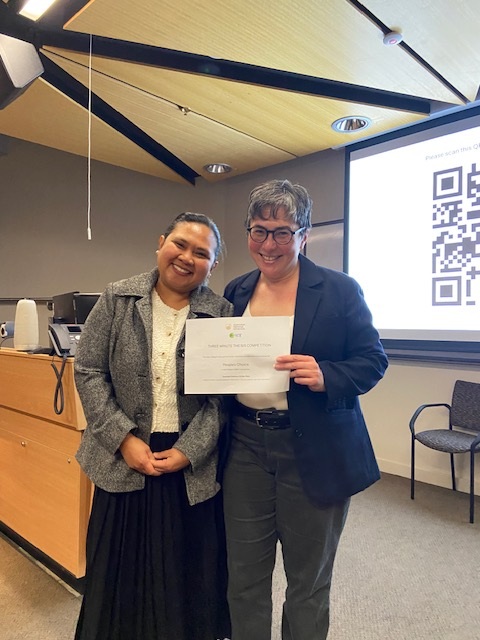
CAP PhD student brings Philippine political research to the ANU 3MT Grand Final

Mary Joyce Bulao, a PhD candidate from the Department of Political and Social Change in the Coral Bell School of Asia Pacific Affairs, will represent the ANU College of Asia and the Pacific (CAP) at the ANU Three-Minute Thesis Grand Final 2026, after being selected as one of two CAP finalists.
For Joyce the competition is about much more than presenting years of research in just three minutes. It's about making research accessible, relevant and meaningful beyond the university.
"We don't do research simply to accumulate knowledge, bind it into a book, and leave it on a shelf to gather dust," she says. "We do research to understand the world more deeply. By learning how to communicate our work, we move one step closer to making someone listen and hopefully laying the groundwork for positive change."
Across the College, higher degree research students are working on some of the most pressing political, economic, social and security questions facing the Asia-Pacific. It's a community built on the idea that research shouldn't stop at the journal article; it should feed into policy, sharpen public debate and change how people understand the region. Opportunities like the 3MT competition exist for exactly that reason: to give students the confidence and the vocabulary to take their work beyond the seminar room.
Originally from the Philippines, Joyce spent 15 years as a university lecturer before beginning her PhD at ANU. Her research explores urban political machines in the Philippines and how these political organisations shape elections in places where political parties are comparatively weak. She is especially interested in the puzzle of why some of these machines last for generations while others collapse after a single electoral cycle.
"My study seeks to explain how political power endures and shifts in Philippine cities, while offering insights that could strengthen the country's electoral system," she says.
What brought her to CAP specifically was the chance to work alongside people whose research she had been reading for years. She joined Australian Research Council-funded projects led by Professor Ed Aspinall and Professor Paul Hutchcroft, both leading voices in Philippine and Southeast Asian politics scholarship, and that experience is what settled her decision to pursue the PhD at ANU rather than elsewhere.
"I not only met the authors of books I had long read but also had the opportunity to learn from them directly," she says. "The departmental seminars became a place where you learn not just from the speaker, but from everyone in the room about which questions matter and how best to approach them."
Coming in as an experienced lecturer, she assumed the transition would be straightforward but it wasn't. However, she credits the College's mentoring culture with turning that early wobble into real growth.
"I started the program thinking I would be fine because I enjoyed research and could write, but I soon understood how little I knew and how much I wanted to grow," she says. "I write more slowly now, but every word is deliberate, considered and shaped by deeper learning. I'm grateful for the mentoring I receive and for having supervisors who are consistently supportive, patient and invested in my development."
That kind of close, sustained supervision is something Joyce points to again and again when she talks about what makes CAP distinctive; not just access to leading academics, but their willingness to stay invested in a student's progress well past the first year. Self-doubt, more than the research itself, has been the real hurdle.
"There are moments when I question my ability to deliver results and become unsure of what I'm doing," she says. "It feels like imposter syndrome, everyone around me is so accomplished that I sometimes feel like a speck of dust in comparison."
Her supervisor has been encouraging her to join 3MT since her second year. She kept putting it off until a more personal reason tipped the balance.
"I finally decided to take the leap to encourage my daughter to give herself a chance and embrace opportunities. She's very shy and often sees herself as inferior to her peers, and I want to show her that if I can step forward despite my fears, she can do it too."
Beyond the competition, Joyce is already thinking about where this research goes next: a book that carries her thesis past the university gates and into the hands of readers who aren't academics at all.
"I want the years I spent researching political machines to reach a wider audience and contribute to how we understand political power in the Philippines," she says. "Transforming the thesis into a book would allow me to refine the arguments, deepen the analysis and present the work in a way that is accessible to scholars, students and practitioners."
Her advice to anyone considering a research career is honest and direct.
"A PhD is not about brilliance. It is about grit," she says. "Do not let your life shrink around your research. Keep a hobby, make time for friends and take a family vacation when you can. What matters is consistency, curiosity and the willingness to keep going even when you doubt yourself."
On 10 July, the CAP community is invited to come along and support Joyce and fellow CAP PhD finalist Ayesha Chaudhary as they take to the stage, showcasing the depth and real-world relevance of the research being carried out across the College.